
Batman Begins Review - ★★★★★
Batman begins again.

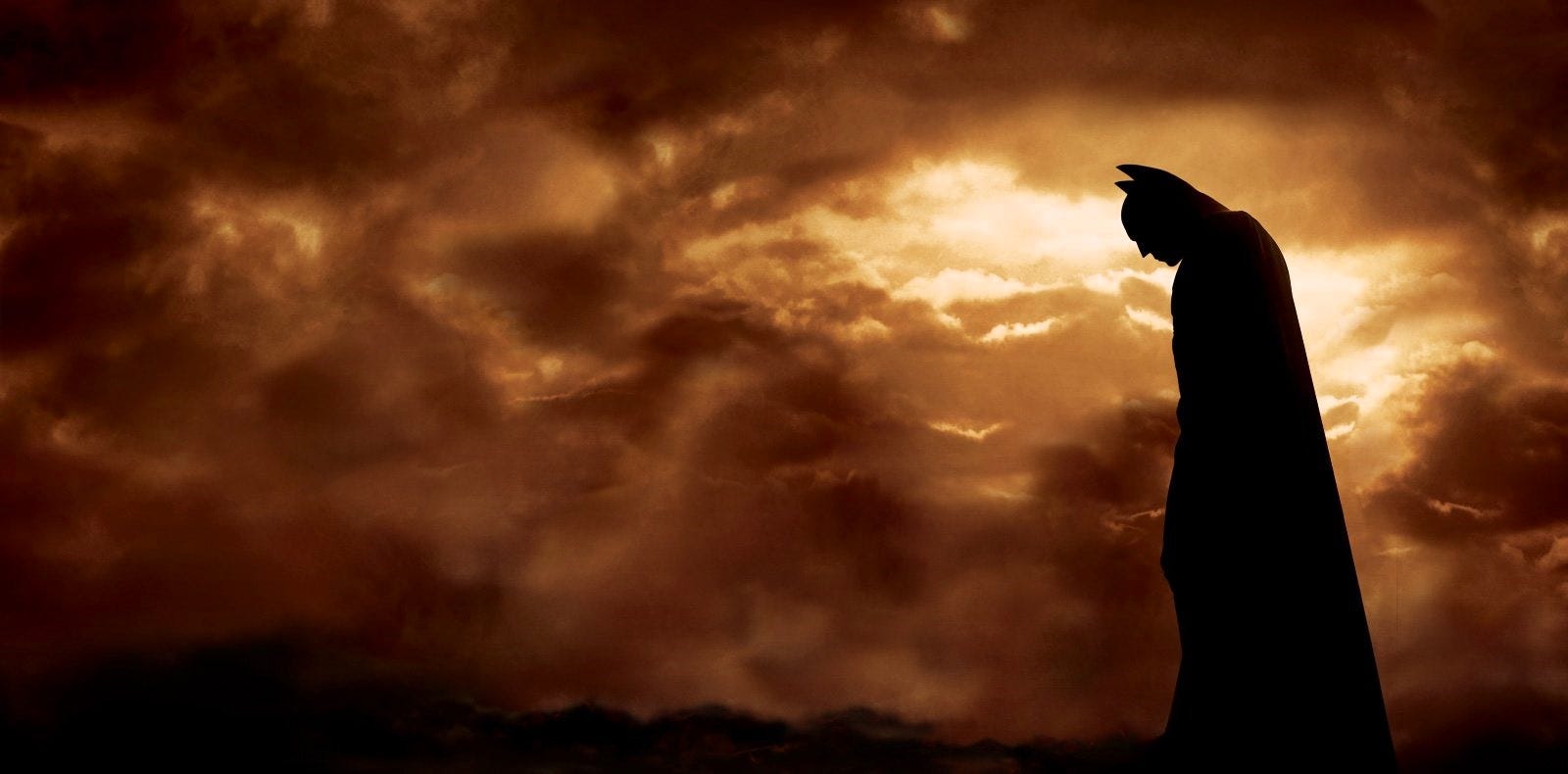
Twenty years on, Batman Begins remains one of Christopher Nolan’s best films and also, in my admittedly contrarian opinion, the best of his Dark Knight trilogy. Up until his decision to re-adapt Batman for the 21st century, Nolan was a promising but unproven writer/director. His early work showed an innovative willingness to play with narrative structure but not a lot of substance beyond that (this is still something that sadly haunts even Nolan’s later, lesser works like Dunkirk and Tenet). Batman seemed to unlock something within Nolan and, vice versa, Nolan found a new moral depth for DC’s most famous icon. Begins is a masterpiece that remains relevant today with its exploration of isolation, trauma, grief, the appeal of absolutist ideologies and the nature of revenge.
We see Batman’s origin story, a story so iconic, it’s near scripture at this point, but Nolan expands his lens outwards, adding new depth and justification to Bruce Wayne’s transformation into the Dark Knight. Nolan’s Bruce Wayne starts as a vagrant, lost in the world, searching for an answer to a question that cannot be answered. We are given flashbacks to show us what led to this prince becoming a pauper. We see a boy with a loving relationship with his parents, rich liberal idealists who preach self-determination (“Why do we fall?”) and use public transport instead of limousines. Nolan robs these liberals of their idealism and also their lives when they are murdered in a back alley by a thief who can’t be reasoned with. How can the young Bruce Wayne continue to believe in the idealism of his parents, the same idealism that led to their deaths? This ironic framing positions Nolan’s take on Batman as a battle of ideologies, a war for Bruce Wayne’s soul.
Young Bruce first blames himself. It was his panic attack in the theatre that caused his father to take him and his mother out. After a recent fall down a well, the traumatised Bruce had a nervous reaction to the performers dressed as bat-like creatures, reminding him of the bats that tormented him in that hole before his father saved him. “If I hadn’t got scared,” laments the young Bruce in a heartbreaking scene to his erstwhile butler Alfred who reassures him and reminds him to only blame the perpetrator and no-one else.
Bruce’s lowest point in the present comes when he ends up in a Bhutan prison cell, a literal metaphor for how the guilt and trauma of his childhood has trapped him. Here, the lost Wayne is visited by the mysterious Henri Ducard, representative of the League of Shadows, a powerful shadow organisation dedicated to battling injustice. Ducard reminds Wayne of his inheritance and promises him true enlightenment if he can deliver a blue flower to the top of a mountain, a trope ripped straight from a classic fantasy novel or an old martial arts movie. Wayne obliges and joins the order, becoming student to Ducard’s mentorship, developing almost a surrogate father/son relationship. Ducard dispenses wisdom to Wayne here that draws from Schopenhauer, Nietzsche (“the will to act”), Machiavelli (”theatricality and deception are powerful agents”) and Adam Smith (“criminals thrive on the indulgences of society’s ‘understanding’”). His absolutist view of the world and morality appeals to the lost and disillusioned Bruce Wayne. They bond over shared trauma and loss and the anger that results from such pain.
Bruce completes his training but is forced to face the larger consequences of the absolute moral (borderline fascist) beliefs of his new masters. They demand he kill a criminal in cold blood. Bruce is shown to have had, at one time at least, the capacity to carry this out in a previous flashback where his lapsed idealism led to him trying and failing to kill the thief who killed his parents, but the interference of childhood friend Rachel stopped him going down that dark path when she chewed him out and reminded him of the value of his parents’ idealism. Here he also received wisdom from another unlikely father figure; crime boss Carmine Falcone, who preached his Darwinian survival-of-the-fittest ideology to Bruce at the other end of a gun (“That’s power you can’t buy, that’s the power of fear”). In Falcone’s example, Bruce is made aware of the consequences of embracing the dog-eat-dog mentality. He sees the end point of the ruthlessness he naively thought he was capable of: his death at the hands of a stronger “dog”.
Back in the present, Bruce tries to reason with Ducard and League leader Ra’s al Ghul with his Western liberal idealism. “This man should be tried,” he mentions, appealing to notions of civilised law. He explains that if they, the supposed bringers of justice, start killing, they’re no better than the criminals they kill, in fact, they may be worse. A fair point, but his new masters demand only blood and Bruce, slowly realising the extent of their capacity for violence and their apocalyptic vision for the world (and, in particular, Gotham), escapes (this is admittedly, the weakest part of Nolan and Goyer’s script, Wayne escapes in a highly destructive way that is inconsistent with his character).
Returning to Gotham, Bruce now has to decide what kind of man he wants to be and wrestles with the various ideologies he has encountered from these father figures. Ducard, Falcone, his real father and even his butler Alfred all showed him possible ways to think and live. Bruce ends up combining elements from all these men for his new identity as Batman (the embodiment of his trauma and fear) but also a new ideology, one that can bring back to life the demoralised and corrupt Gotham but also counter the militant and eschalogical League of Shadows. Bruce incorporates Falcone’s use of power and fear and Ducard’s theatricality and deception, but underpins this with a majority belief in the idealistic principles of his true father, Thomas Wayne, and his friends who carry on that legacy, Alfred and Rachel.
He also finds a like-minded ally in Gotham police detective Gordon, a man who comforted him as a child in his darkest moment and whose character, like pre-Batman Bruce, represents lapsed idealism in the face of real-world despair. Batman brings Gordon back around to his senses and reignites his moral core just in time for them to face the psychopathic Scarecrow, the expanding criminal aspirations of Falcone and an invasion from the League of Shadows.
What makes Nolan’s exploration of these ideologies still interesting all these years later is that he portrays these colliding ideologies fairly. Lesser filmmakers and writers, like those who dominate Hollywood now, tend to lean into characterising those who are politically or philosophically opposed to their milquetoast elitist neoliberal beliefs as cartoonish pantomime villains. This is a naive view rooted in the mediocrity that infects much of liberal thought now, a mediocrity driven by self-assurances of being morally righteous by default and on “the right side of history”, fallacious notions that render liberals and their morality weak and passive in the face of ever-worsening political and cultural defeats. See how trash like South Park gives liberal-minded viewers what they think they want; apparent easy wins in the cheap mockery of their opponents, while their opponents take control of institutions, their rights are still stripped away from them and people begin to wonder what the goals of liberalism even are anymore.
Nolan understands the appeal of fascism and absolute morality, particularly to lost young men like Bruce Wayne, and is therefore able to give us a meaningful exploration of how people fall into these radicalised belief systems and how they may pull themselves out. He presents these ideologies with absolute seriousness and sincerity while also showing their destructive nature and rooting in solipsism. Ducard tries to justify his destruction of Gotham as a “necessary” and justified evil but there’s an undercurrent of it actually being motivated more by his out-of-control trauma rather than logic or rationality. The main difference between Wayne and Ducard is that Wayne has compassion from the memory of his parents’ love and also from friends not afraid to challenge him, this allows him to heal from this trauma and overcome his destructive anger. It also gives him hope, that if Gotham can produce people like Rachel, Alfred and Gordon, it deserves to be saved, no matter how bad it may be. This hope motivates him to fight for Gotham, rather than destroy it, and for all of its people. Ducard, having cut himself off from compassion (he even warns Bruce about it at one point, viewing it as a weakness), cannot undergo the same redemption and process of understanding that Bruce does because he’s not open to it. See how, when Bruce does challenge him with justified compassion, much like how he was challenged by Rachel when he nearly killed Joe Chill, (“Give me more time, there are good people here”), Ducard and the rest of the League refuse to listen, burning down Wayne Manor at the movie’s midway point.
Nolan’s approach is far more effective in disarming these belief systems than if he had merely portrayed Ducard and the League as bumbling buffoons or scatological freaks (à la Pasolini). This, of course, caused some critics to decry Begins and the rest of Nolan’s trilogy as “conservative” because he dared to show some of the modern failings of liberal democracies (corruption, injustice, passivity, demoralisation) and portrayed opposing idealogues with competent intelligence but Begins is actually the type of meaningful and complex culture that liberals have become unable to generate as of late, the kind that actually demonstrates liberalism’s moral tenets but also its failings, rather than merely acting as a one-sided circlejerk to convince viewers that they’re on the “right” team. It’s not pro-liberal, but it’s also not pro-conservative and certainly not pro-fascist either. This is a movie that believes in compassion, faith in others and the idea of fair justice but it also isn’t afraid to show how these beliefs often clash with reality and the unyielding will of disillusioned lapsed believers like Ducard who want to destroy it all. Because of this, it achieves a moral and philosophical complexity that mirrors real-life and makes it far more valuable and intriguing than most deliberately “intellectual” or political arthouse films. No mean feat for a mere comicbook movie.
Batman is only able to defeat Ducard at the movie’s climax by exploiting a logical loophole in his own moral framework. He doesn’t kill Ducard, he just simply doesn’t save him. He wins but at the cost of stretching the morality of his beliefs to their absolute limit. Only a cynic like Nolan (perhaps cinema’s most insightful and intelligent cynic since Kubrick or Friedkin) could write an ending like this that exposes the inability of liberal idealism to deal with those who would use its open nature for their own ends. Is Batman a hypocrite for doing this? It raises interesting questions and discussions. (There’s also a genius parallel framing here between Bruce’s two main father figures. When Thomas Wayne gets shot earlier in the movie, Bruce looks down at him as he dies. “Don’t be afraid,” are his last words to Bruce. When battling Ducard on the train, he overpowers Bruce and repeats Thomas Wayne’s dying words (unknowingly) back to Bruce. This time Bruce is looking upwards at Ducard, a very interesting inversion.) In the end, Batman lets Ducard be killed by the runaway train he set loose, a fitting metaphor for how extremist beliefs and a lack of compassion destroy those who embrace them fully.
Nolan’s casting of Liam Neeson as Ducard (later revealed to be the true Ra’s al Ghul) is a stroke of subversive brilliance, perhaps the best villain casting since Sergio Leone’s use of Henry Fonda in Once Upon a Time in the West. Neeson is, of course, a great paternal force in cinema and he evokes previous performances like that of Oskar Schindler and Qui-Gon Jinn. What makes Ducard such a terrifying villain (and even better than The Dark Knight’s Joker) is that he is right, to an extent. Neeson gives Ducard’s philosophy a tantalising authoritative appeal. When he paraphrases Adam Smith’s adage “Mercy to the guilty is cruelty to the innocent,” or the vaguely Marxist “Create enough hunger and everyone becomes a criminal” (a paraphrased version of that old Lenin quote, “Every society is three meals away from chaos”), it’s hard to disagree with him.
Nolan manages to get career-best performances out of just about every member of his cast. Bale is superb, essentially playing three characters (the real Bruce Wayne/partyboy millionaire Bruce Wayne/Batman) with the dextrous skill of Peter Sellers in Dr. Strangelove. As Bruce, Bale exudes a quiet courage, a stoic temperament and a competent capability that makes his Bruce Wayne that best on-screen depiction of the character to date. While his Batman isn’t as good as Kevin Conroy, it’s still solid. His voice in particular receives a lot of criticism but in the context of Nolan’s movie, Batman represents a primal force of dark justice, so his bestial voice can perhaps be forgiven for being slightly over-the-top. He does a good job in Begins of keeping it coherent when needed and scary only when intimidating criminals (there’s none of The Dark Knight Rises‘ over-the-top, constant ultra-macho screaming, i.e. “WHERE’S THE TRIGGER?!” asked Batman calmly).
Caine is wonderful as Alfred. A particular highlight is the scene where the errant Bruce returns to Wayne Manor from Princeton and insults the responsibility of his inheritance which allows Caine’s Alfred to act as a moral check for Bruce’s behaviour. This faith moves Bruce at another of his lowest points (”You still haven’t given up on me”) and pays off later in an even more moving scene in which he and Bruce escape the burning Wayne Manor and Bruce beats himself up for not realising the League’s true intentions sooner. He repeats the adage of Bruce’s father, (“Why do we fall?”) and reconfirms his intention to never give up on his charge. From the mouth of a lesser actor this dialogue would be trite, but Caine’s ability makes it sublime, as does Bale’s emotional reaction to this display.
Cillian Murphy’s Scarecrow isn’t as effective a villain as Neeson’s Ducard but still a very welcome addition. Rutger Hauer and Morgan Freeman are also welcome additions that bring a lot to the table (as they always do), with Hauer playing a slimy executive playing power games and Freeman playing Lucius Fox, essentially Batman’s Q and a former confidant of Bruce’s father who has been relegated to Wayne Enterprises’ basement.
Gary Oldman plays Detective Gordon with warmth and relatability. First he’s just a regular cop, set in his passive acceptance of the rotted norm (”In a town this dirty, who is there to rat to anyway?”) but he springs to life when Batman presents the opportunity of building a better Gotham. Katie Holmes does her best as Rachel, a headstrong lawyer not only unafraid to challenge the criminals of Gotham but even her billionaire friend Bruce, both early in the film when he tries to kill Joe Chill and also later when he returns to Gotham and engages in his playboy playacting for the cameras. In one of the movie’s best scenes, Bruce (as Batman) feeds her back her moral indictment of his wanton ways (“It’s not who I am underneath but what I do that defines me”), revealing both his identity but also the fact that Bruce took her indictments very seriously. It’s a great pay-off for Rachel’s strife throughout the film and confirmation that her unwavering idealism got through to Bruce, a beautiful reminder that lost souls like Bruce need love and also tough but fair challenging of their beliefs and behaviour.
While she is Bruce’s love interest, the ending (in the vein of Sam Raimi’s Spider-Man), refuses their relationship. Much like Frodo at the end of The Lord of the Rings, Bruce’s time away in isolation, exploring dark ideologies has changed him and his embrace of the monster that was produced from his experience makes such a relationship impossible. The time has passed. Bruce’s soul has been saved but at a cost. He is changed forever. He and Alfred wander the ruins of Wayne Manor and Bruce confirms his commitment to the idealism of his parents. Earlier, he described his family home as a mausoleum and said he desired to take it down brick-by-brick. Now, amongst its ruin, he states that he’ll rebuild it brick-by-brick, embracing the responsibility of his inheritance.
Nolan and Goyer’s script is superb, the acting is terrific but what about the visual component of the movie? While it lacks the visual richness brought about by Nolan’s later commitment to the IMAX format and pure practical effects (Begins actually features some dated CGI shots, a rarity in Nolan’s catalogue), Begins is a terrific looking movie. The practical sets are gorgeous to look at and go a long way to realising Nolan’s dark and gothic depiction of urban decay. The Gotham ghetto featured at the film’s climax was specifically modelled on Blade Runner but also has a lot of resemblance to The Crow’s depiction of an urban hellscape. The score is terrific too, composed by both Hans Zimmer and James Newton Howard. Begins has a much softer score compared to later Dark Knight soundtracks, where Zimmer’s maximalist tendencies would take over. Newton Howard’s influence would be sorely missed from these later scores as he seemed to bring a delicate touch that enhances Nolan’s characterisation and reinforces the tragic suffering of Bruce Wayne.
To sum up, I really do think Batman Begins is a masterpiece. People clamour for The Dark Knight, the follow-up to Begins, and while I also believe The Dark Knight is a masterpiece, I think Begins deserves a place right next to it. Nolan’s exploration of morality and ideology is so fascinating and because Ducard is such an effective villain, I actually think Begins might even be better, but that’s just my (very) idiosyncratic opinion. Begins is a remnant of a lost cinematic age when comic book superhero movies could actually have philosophical depth and speak to elements of the human condition in a profound way. An age that has been lost in pursuit of industrialised blockbuster cinema, with these comic book movies now essentially coming out of a factory at a steady rate, designed for mass consumption and nothing more and the capacity for them to carry the thoughts of interesting directors like Nolan completely gone. Time will tell if blockbuster cinema can reach the brilliance of Begins and Nolan’s Dark Knight trilogy ever again. I hope so.