
Mixtape Review — ★☆☆☆☆
A fake game for fake people.

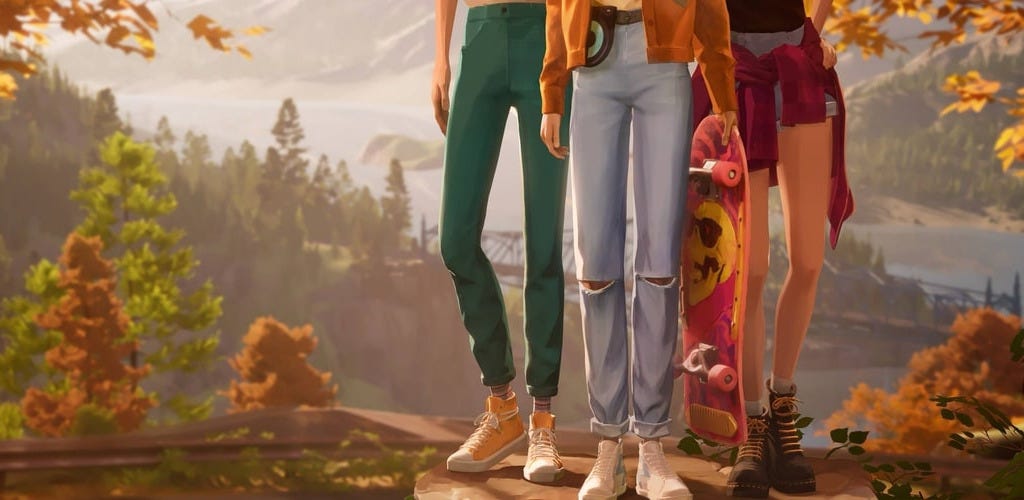
Mixtape is the latest astroturfed “indie” game to receive endless adulation from the most annoying people you know.
Everything about this three-hour non-experience is fake. It isn’t a game, because it features next-to-no interactive elements and has all the gameplay depth of someone dangling keys in your face. It uses the cultural aesthetics of the 90s as a superficial stylistic crutch, producing nothing more than a hollow simulacrum of that era. It’s not an indie game, it features an extensive licensed soundtrack, various product placements and was bankrolled by Annapurna Interactive, a major publisher owned by the daughter of pro-Israel, pro-Trump billionaire Larry Ellison, one of the world’s wealthiest men. Even the response to this game is fake, largely driven by an out-of-touch game journalist class and disingenuous streamers merely looking for their next cross-promotional opportunity.
An unprecedented full-mark IGN review places Mixtape alongside actual gaming masterpieces to have received the same honour (or perhaps now a pseudo-honour) such as Ocarina of Time, SoulCalibur, Pokémon Gold and Silver, Grand Theft Auto IV, Breath of the Wild, Super Mario Odyssey and Red Dead Redemption II to name just a few. That’s to say nothing of the videogame masterpieces that IGN have failed to identify over the years as well. To even suggest that Mixtape is anywhere near these true masterpieces is an insult to the videogame form.
The fact that Mixtape hasn’t been identified immediately as hackwork reflects poorly on the videogame critical apparatus to actually do its job. This critical apparatus is too hung up on its own partisan nonsense to function correctly anymore, so any praise Mixtape or similar games receive is now immediately cast into doubt. Is it good because it’s good or because it “owns the chuds”? We don’t know anymore.
Look at the previously mentioned games. Mixtape does nothing to justify its placement next to them. There is nothing of substance here; no gameplay depth, no stylistic or aesthetic excellence, no storytelling prestige. It’s an anti-game made by hack artists whose work is utterly repulsive on every level.
The first element to address is Mixtape’s central aesthetic gimmick. Mixtape markets itself as providing an authentic recreation of the 1990s and yet its depiction of this cultural environment feels hollow and superficial, reducing this era to a series of cheap “memberberries”. Remember cassette tapes? Remember skateboards? Remember Blockbuster?
None of what it offers seems to reflect the 1990s in any meaningful way, failing to capture the liberalised landscape of that era or the destructive cynicism, anger and unfulfillment of Gen X. This is because no work produced in our hyper-restrictive, ultra-partisan modern culture can depict any past era fairly. See how the recently released Mouse P.I. used the aesthetic of 1930s America and yet had little reference to prohibition, gangsters or economic depression, instead placing the majority of its focus on Nazis and fascists, a decision driven by modern partisan desires.
Mixtape also promises a nostalgic coming-of-age story and yet this is consistently undermined by the game’s over-reliance on ironic disaffected cynicism. This creates a constant tonal imbalance where Mixtape never seems to know what it is or what it’s trying to do. The “coming-of-age” story can’t exist in our modern culture which is too infected by the very same ironic snark that ruins any possibility of Mixtape presenting its world or its characters with any sort of earnestness. If the writers aren’t willing to take this seriously, why should anyone else?
Mixtape’s depiction of the coming-of-age story is also woefully out-of-touch and irrelevant. In our post-COVID, hyper-nihilist cultural era of multiculturalism, globalism, incels, e-thots, grifters and rage-baiters how can anyone, under the age of forty, possibly relate to a bunch of self-absorbed privileged bourgeois teen delinquents running around the 1990s with no consequence? My teenage years took place at the beginnings of our new technology fueled, dystopic panopticon during one of the worst economic crashes in history. How can I relate to Mixtape?
Of course, one need not relate to a game in order to appreciate it, but Mixtape sells itself on that premise and offers nothing of depth as alternative, beginning to feel like nothing more than a contrived excuse for the staff to show off their milquetoast taste in music. The soundtrack is, admittedly, the one decent element of Mixtape, but much like the game’s aesthetic, many of the songs selected feel superficial and detached from the era the game is supposed to be recreating. There is a lot of what I call modern “algorithm bias” in this soundtrack, that is to say, songs that have been selected not because of their relevancy to the period setting but because they came up in some Spotify playlist of “Obscure 90s Classics” that the music director was listening to or something.
There are numerous picks from this soundtrack that are overly contrarian or simply don’t fit the context of the game’s setting. Many of these songs were inaccessible to the average teen in the 90s because people still had to actually go out and buy CDs and cassette tapes, which were expensive. One CD back in 1999 would probably cost what an entire month of Spotify Premium costs now. There was no “all-you-can-eat” subscription model to engage with music, so many of the songs that comprise Mixtape’s soundtrack languished in obscurity until the era of the MP3, file sharing and aforementioned subscription services made actually hearing these tracks a lot easier. Mixtape doesn’t actually care about its setting.
See the inclusion of David Gray’s ‘Shine’. No one cared about David Gray until the release of his album White Ladder in 1998. Gray’s career had floundered so badly that White Ladder was intended to be his retirement album until, thankfully, a series of successful singles (‘Babylon’, ‘Please Forgive Me’, ‘This Year’s Love’) propelled it to become one of the best selling albums of the era. It’s highly unlikely that anybody, never mind an American teen, in the 1990s would have been listening to Gray’s first album and, in particular, the non-single track that opens it.
The same can be said of many of the other inclusions. Were American teens of this era really listening to the likes of Joy Division, Roxy Music and DEVO over newer contemporaries such as Nirvana, Pearl Jam, Alice in Chains or, if you want to push further into the 90s, Limp Bizkit, Linkin Park or Blink-182? Lush are introduced as one of the first “shoegaze” bands. They weren’t. They were also largely unknown outside of Britain until their reunion last decade and even then they remain one of the lesser known shoegaze bands. Cocteau Twins have a more valid claim to the title of shoegaze originators and merely get paid lip service by the game (thankfully 4AD must have told Annapurna to do one, thus sparing the band’s legacy). “Shoegaze” also wasn’t a genre in the 90s, it was a pejorative term invented by music journalists to insult bands like Slowdive or My Bloody Valentine who spent most of their concerts staring at guitar effect pedals, or, “shoegazing”, if you will.
Another display of hackwork is the inclusion of The Jesus and Mary Chain’s ‘Just Like Honey’ and Roxy Music’s ‘More Than This’. The more cinematically experienced among you will identify both of these tracks as having already been featured in Sofia Coppola’s 2003 film Lost in Translation. While there’s nothing to stop a music track being featured in more than one film or TV show or videogame, there is something rather lazy indicated by the fact that Mixtape features not one, but two songs from that film’s soundtrack. Again, this displays Mixtape’s mediocre approach to creating its environment.
Mixtape is a work rooted in ego, so the desires of its creators come before accurately reflecting the cultural period it actually takes place in. This also reflects in the central trio of characters who are utterly insufferable. They are depicted as self-absorbed, over-emotional and immature throughout the game with no resolution to these toxic behaviours. There’s no punishment for their hubris or any sort of redemption where they finally grow up. This type of characterisation is typically found in torture porn movies such as Final Destination or Scream where the teens are deliberately depicted as unlikable in order to justify the atrocities that are carried out upon them later, but Mixtape isn’t a horror game. It thinks these characters are “relatable”.
The writers’ arrogant, self-absorbed solipsism is confirmed by an increasingly absurd sequence near the game’s end where a convoy of cars descend on the gang’s hidden forest shack for a party. Fireworks explode overhead but despite Mixtape’s modern graphical fidelity, it fails to match the far superior Ridge Racer Type-4’s implementation of this same concept despite that nearly thirty-year old game suffering from the limited capabilities of the first PlayStation. The cars then start flying, Harry Potter-style. Do you get it? Whoa dude, this is like a metaphor for the freedom of youth and stuff. It’s trite nonsense. Mixtape has nothing interesting to say about youth or nostalgia.
The writers attach too much importance to their own memories. There’s no sense of longing here, an essential component of any work tackling nostalgia. Compare this to George Orwell’s anti-nostalgia masterpiece Coming Up for Air which treats nostalgia as what it is— a folly. That book sees middle-aged George Bowling try to escape his mediocre life and impending war by returning to his childhood town of Binfield, only to find the place degraded by time and the creep of industrial modernity. Orwell’s approach is cynical but necessary to deal with the disease of nostalgia, a disease that prevents progress and awareness of the current moment.
Millennial creatives continue to prove themselves incapable of growing up and our culture suffers as a result— trapped in an endless Ouroboros loop, eating its own output recursively, over and over. Mixtape feels like it was created by people suffering from arrested development, featuring the usual hallmarks of that generation’s juvenile writing; a juvenile view of freedom not rooted in morality, but instead centred around hedonism (the gang’s central quest is to get either drunk and stoned) and a juvenile view of power where this lifestyle should come before the influence of parental or societal desires. See the climatic scene in which Cassandra threatens to burn down a forest because her cop father (of course he’s a cop) has an issue with her getting shit-faced and wasting her life away.
Compare this to Spider-Man’s first appearance in Amazing Fantasy #15, a coming-of-age story that’s actually effective and Uncle Ben’s eternal message to Peter Parker; “With great power, comes great responsibility.” The arrogant Parker, having just gained his superpowers (a metaphor for teenage self-determination) arrogantly dismisses his uncle’s wisdom, drifting further and further into egotistical selfishness. This culminates with Parker letting a thief get away because the promoter he stole from stiffed him. The punishment for Parker’s hubris is that this same thief then goes on to kill his Uncle Ben. In one of the greatest moments of modern storytelling, Parker, as Spider-Man, apprehends the killer only to realise that it was the thief he let get away. In that moment, Parker is forced to grow up and actually accept that his uncle was right: power does require responsibility.
Amazing Fantasy #15 works all these decades later because it’s a universal story, detached from time, place or even culture, like all the best stories. It stands alongside the greatest of Greek myths and the likes of The Odyssey, Don Quixote and The Count of Monte-Cristo because it was written by an adult (the great Steve Ditko) who had a fully-formed philosophy and an intent beyond the superficial desires of the modern writer. The same will never be said of Mixtape, no matter how many ten-out-of-ten reviews are thrown at it.