
The Odyssey Review — ★☆☆☆☆
Nolan flies far beyond his creative and intellectual limits and falls flat like Icarus.

Introduction
This is a long (very long) review of Christopher Nolan’s new adaptation of The Odyssey, split into six parts (called “books”, like Homer’s original text). Book I gives some explanation for why Nolan chose to adapt The Odyssey. Book II is my review of the film itself. Book III concerns some of the changes that Nolan made to the original work. Book IV describes Nolan’s cowardly capitulation to modern ideological whims such as radical feminism. Book V describes Nolan’s butchering of the English language. Book VI is a brief conclusion. Thank you for reading.
Book I: “A man’s got to know his limitations.”
“A man’s got to know his limitations.” So goes the final expression uttered by Clint Eastwood at the end of Magnum Force, the 1973 sequel to Dirty Harry. Indeed, truer words might never have been spoken in the history of cinema. A man does indeed need to know his limitations so as to avoid failure, humiliation or even death. Try telling that to Christopher Nolan however.
Nolan no longer needs to acknowledge this universal aphorism. He is beyond “limitations”. Over the last thirty years, Nolan has established himself as the leading film-maker of our time, regardless of what you or I may think about his oeuvre. The man can do no wrong in the eyes of Hollywood—he even managed to make a billion dollars out of a film about Oppenheimer for goodness’ sake. He is one of the few modern film-makers to have carte-blanche status with just about every studio out there.
For the record, I’ve mostly liked Nolan’s work up until now (with a few exceptions) but not for the reasons that many others seem to. Most Nolan fans seem to always highlight his “intellectualism” as the reason he demands respect, as if this in and of itself translates to competent film-making. These people forget that film-making is not an intellectual art-form, it’s an instinctive one.
Funnily enough, the films in which Nolan’s intellect overtakes his instinct are his worst; Memento, Dunkirk and Tenet all suffered as a result of Nolan’s pseudo-intellectual fixation on obfuscated presentation, structural fuckery and his compulsive need to explain, in literal terms, the fantastical elements of the worlds he created. Nolan’s best works focus on strong characterisation, classical storytelling and a more subtle manipulation of structural form with clear creative intent. See The Dark Knight trilogy, The Prestige, Inception, Interstellar and Oppenheimer as gold examples of this.
For all the talk of how “intellectual” Nolan is, his works haven’t really displayed this. Comparisons to Kubrick constantly endure and yet Nolan’s work has never really reached the intellectual heights that Kubrick’s did. His work typically tackles the realms of comic-books or pop science or pop psychology. Kubrick adapted Nabokov, Burgess, Thackeray and Schnitzler while Nolan makes Batman movies. This is not a criticism by the way, as I mentioned, Nolan is at his best when he follows the K.I.S.S. principle and understands his limitations.
The closest that Nolan has come to interpreting a high-brow work was Oppenheimer, which was itself an adaptation of American Prometheus, the 2005 biography of the titular J. Robert Oppenheimer. Again, however, Oppenheimer was hardly an intellectual work. Nolan’s strong character work and understanding of classical archetypes created a film with a universally understandable story—the tortured, obsessive genius who opens Pandora’s Box, a classic premise which follows many of the same thematic trace-lines of his other work (see: Inception and The Prestige). Simple.
It was somewhat surprising then, when Nolan announced he had decided to adapt Homer’s The Odyssey when there’s not really a precedent for this in Nolan’s back catalogue. Most of his previous films are either original works or adaptations of comic-books. It would be like Zack Snyder announcing he intended to adapt The Aeneid or The Divine Comedy — not necessarily unwelcome, but befuddling. Despite this, there are some shared stylistic elements between Nolan’s sensibilities and Homer’s epic poem.
The Odyssey features; a non-linear story (Memento, Dunkirk), a tale of a boy, Telemachus, becoming a man (Batman Begins), Odysseus trying to get back to his home and child (Interstellar), Odysseus being ensnared by the desires of two possessive women, the nymphs Circe and Calypso (Inception). So, it somewhat makes sense. However, I think Nolan’s choice to adapt this work was motivated by a massive chip on his shoulder. I believe Nolan is aware of the lack of high-brow material in his previous work and deliberately chose The Odyssey as a way to counter-act this.
The Odyssey is one of the few remaining literary works to have never had a true big-screen adaptation in the modern era. There was Ulysses, a 1954 Hollywood adaptation starring Kirk Douglas, Nostos: The Return, an abstracted adaptation released in 1989 by Franco Piavoli that focused more on the spiritual element of Homer’s work, The Odyssey, a Hallmark television adaptation from 1997 directed by former Tarkovsky collaborator, Andrei Konchalovsky and produced by Francis Ford Coppola, that managed to embody the source material very well despite its limited means and The Return a 2024 film that only covered the final part of Homer’s epic saga.
So, Nolan’s choice to adapt this work seems fuelled by a desire to prove himself as beyond the intellectual standards previously established by his work. He wants to prove himself as a director at the level of a Kubrick, a Tarkovsky or a Malick who can adapt difficult, highbrow material for the screen. But as mentioned at the start of this review: “a man’s got to know his limitations.”
Nolan seems to have forgotten his, because his adaptation of The Odyssey is a disgrace. Not only that, but it is the worst film Nolan has ever made.
Book II: All hail IMAX, the god of mediocre cinema
In my recent retrospective of The Fellowship of Ring, written for its twenty-fifth anniversary (currently in progress, I will update when finished), I laid out the sorry state of cinema at the turn of the twentieth century and how that film essentially restored the live-action Western cinematic form, reminding viewers of what heights it could attain if creatives respected the Western cultural canon and created works that embodied the essence of mythological and classical storytelling.
Cinema once more finds itself in a languished, sorry state and the hope of many viewers, myself included, was that a Nolan adaptation of Homer’s timeless epic would perhaps be the work that would restore cinema culture back to the level it once enjoyed. But it is not to be. Western cinema culture is so utterly incompetent that not even a Christopher Nolan adaptation of The Odyssey can save it. Let me just say that again: a Christopher Nolan adaptation of The Odyssey is not enough to save cinema. This would have been unthinkable even a decade ago, now it’s reality.
The destructive creative apparatus under which films are now produced renders Nolan’s The Odyssey as worthless pop-consumerist trash — nothing more than an extended technical demo for the IMAX format in much the same way the more over-bearing elements of Peter Jackson’s The Return of the King served as extended demos for WETA Digital. That film was saved by Jackson’s genuine reverence for J.R.R. Tolkien’s original work — the same cannot be said of Nolan and Homer. Nolan unwisely reinvents core elements of Homer’s work believing himself to be a superior writer. As evidenced by the final product, this is not true.
Nolan is beholden to the IMAX format because he is a technocrat materialist who cares more about the format and mechanics of film rather than film itself. This allegiance to IMAX has had a negative effect on his previous work — Nolan’s infamous inaudible dialogue is caused by the physical noise of the IMAX cameras and his reluctance to use ADR.
Now, with The Odyssey being filmed entirely in the IMAX format, for the first time, an entire Nolan film is compromised by this format. While the IMAX cameras may be less noisy, they are still bulky, which reduces the kinetic possibilities of shots and sequences — rendering much of The Odyssey as static.
They also remain incapable of filming extended scenes — Nolan bypasses this flaw by utilising bizarre staccato TikTok-style short-form editing. An early dialogue scene between Antinous and Telemachus features so many edits between over-the-shoulder shots that it has to be seen to be believed. It is utter hackwork.
The end result feels like nothing more than an extended show-reel for the format. Perhaps Nolan should have cut out the decent scenes from this film, gave it an hour runtime and called it: “Scenes from The Odyssey, shot in IMAX”. The IMAX format doesn’t allow for any sense of natural flow to be built up within the film.
Worst than all this — The Odyssey is boring. Nolan’s aesthetic sensibilities are not compatible with Homer’s and there’s no effort on his part to try and even meet Homer half-way. Through Nolan’s aesthetic lens, Homer’s work becomes milquetoast and weak. His version lacks the spiritualism, sensuality and eroticism of the original. It’s stale, sterile and sexless — all the richness of Mediterranean culture filtered through a lens of pseudo-intellectual Anglo-Saxon drudgery.
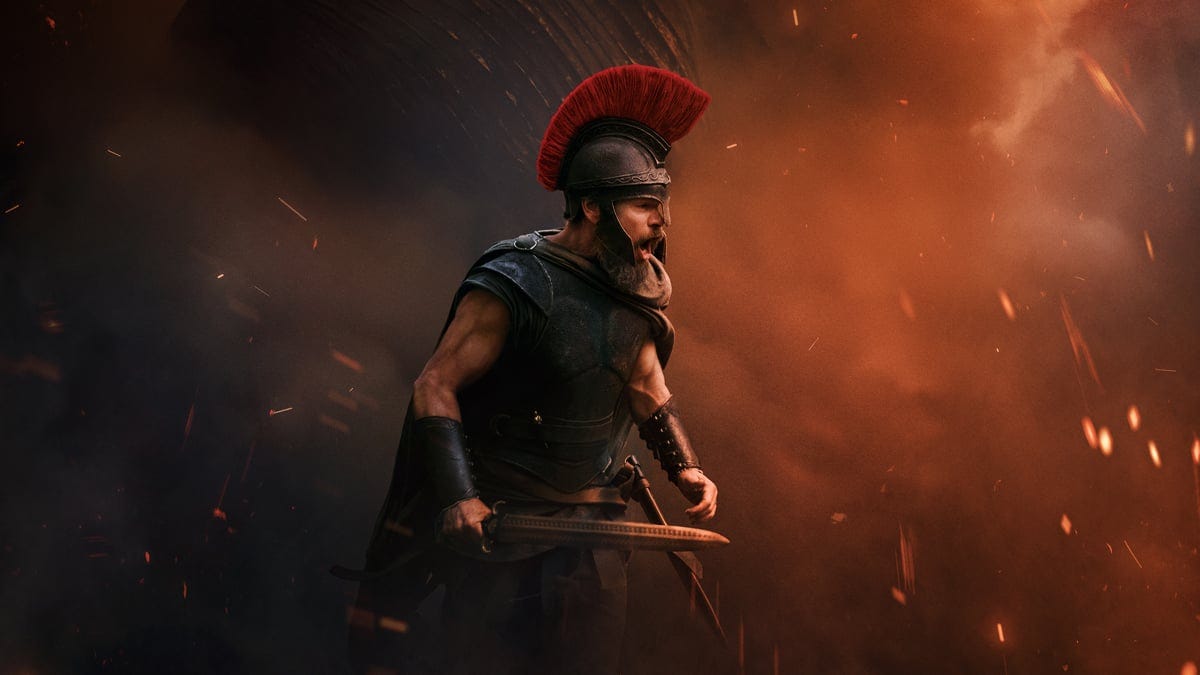
See the costume design as a prime example of this — it’s laughable, with Homer’s great archetypes reduced to looking like cheap LARPers at a medieval fair. Nolan is entering unfamiliar tonal territory with The Odyssey and he cheaply apes the aesthetics of Ridley Scott (Gladiator, Kingdom of Heaven) and Terrence Malick (The New World) rather than creating his own. This is not good enough to serve as even a simple adaptation of one of the great literary works of the Western canon, never mind the “definitive” adaptation.
For all the effort of shooting on-location at many of Europe’s most beautiful spots, Hoyte van Hoytema’s cinematography renders these locations as sterile and boring with a muted colour palette that fails to communicate the richness of these locales. Jennifer Lame’s editing is confused and ineffective. Limited by the IMAX format, over ninety hours of footage and a demand for a three-hour runtime, Lame fails to render an effective version of this story, relying too much on Family Guy-style cutaways to provide context.
Much has been said and written of this Greek-less cast (including by me) but their worst offence ends up being not their diversity but their ineffectiveness. Tom Holland (a thirty-year old man) is woefully miscast as the boy prince Telemachus, as is Jon Bernthal as Menelaus, who plays the legendary Greek King like a mildly pissed-off New York deli-owner.
Anne Hathaway’s botox prevents her from emoting as Penelope and she has to rely on weepy histrionics and over-acting to get her point across. Zendaya depicts Athena with moody languid mannerisms, playing the mighty goddess like someone who’s just been woken up and told they start work in thirty minutes a half-hour ago, robbing the goddess of any sense of the divine.

Elliot Page appears twice as “Sinon”, a character not in the original text, and gets put over as “the greatest soldier I’ve ever known” by Matt Damon’s Odysseus while Lupita Nyong’o shows up for even less time. (Remember when I predicted in my “Where are the Greeks in The Odyssey” article that these casting choices were nothing more than token picks designed to allow the film to qualify for the Oscars and nothing more? Yeah.) John Leguizamo shows up in White-face so bad it’s comical. I assume it’s okay for Latinos to take Greek roles but not the other way around? Interesting ideology from a man most famous for playing Luigi.
Damon plays Odysseus as a dim dullard, failing to convey his guile, wit or charm. His characterisation gets too caught up in modern-day pathological bullshit. He plays Odysseus as a tortured PTSD-suffering veteran rather than a man who simply wishes to get home — overcomplicating what doesn’t need to be complicated. Much of this cynical characterisation is deliberate, as Nolan’s adaptation is a deconstruction of Homer’s original work (more on this later).
Nolan’s casting choices also produce some unintentionally hilarious results. Himesh Patel saying “We’re Greeks, from Ithaca” might be the funniest line in a Nolan movie since “For you.” Also hilarious are Matt Damon’s lines; “Our age of bronze is ending” and “Sheep move in flocks.” Yes, what a great depiction of one of the wisest warriors to have ever lived.
No-one stands out here, no-one elevates the source material (but I must give some praise to “Nobody”, who is fantastic in the film).
The soundtrack work by Ludwig Göransson is also pitiful. This is, without doubt, the worst score ever featured in a Nolan film which is a genuine travesty when one considers the quality of music provided by previous Nolan films and long-serving Nolan collaborator Hans Zimmer. Some of these scores rank amongst Zimmer’s best work. Göransson is a poor substitute for Zimmer and a weaker Jóhann Jóhannsson (rest in peace). Nolan requested Göransson to avoid using a traditional orchestra because they didn’t exist in Ancient Greece or something (neither did IMAX cameras, you utter mid-wit).
I guess Nolan also told Göransson to avoid including any sort of memorable melodic passage, any use of harmony or any other kind of sonic richness too. The entire score is a dissonant mess with absolutely nothing to offer. It is nauseatingly bad. Just as with the casting, there are no homages to Greek culture either. This is a meandering, weak and ineffective score that provides nothing of meaning to the accompanying imagery. Eduard Artemyev’s score for the 1997 television adaptation was far superior and actually honoured the Greek origins of the story.
The one thing Nolan gets right is the technical element of the film. The Odyssey’s commitments to on-location shooting and its use of practical effects are commendable. But effects don’t make a movie. If this were true, people would have to finally agree that George Lucas’ Star Wars prequel trilogy is the greatest in cinematic history. Nolan also includes Argos’s death, perhaps the most emotional moment in any story ever — but Homer gets the credit for this moment of genius, not Nolan.
Every moment of Homer’s epic is rendered lifeless through Nolan’s sterile cinematic vision. Argos’ death doesn’t truly move the heart the way it does in Homer’s original text. Neither does Telemachus’s reunion with his father, perhaps the greatest moment in all storytelling. With a mere few paragraphs to describe each event, Homer does more than Nolan with his hundreds of millions of dollars and his Hollywood actors and his IMAX cameras.
The film’s scant highlights include the Cyclops cave, Argos’ death and the killing of the suitors. It’s rather telling that the strongest parts of The Odyssey are when it actually follows Homer’s blueprint faithfully. Fragments of what this film could’ve been only serve to highlight its total shortcomings. Why didn’t Nolan just follow the path that Homer set for him?
Book III: Twilight of the Idol
The Odyssey opens with a line of text that sets out Christopher Nolan’s modus operandi: “A time of apparent magic...” This immediately exposes Nolan’s hack deconstructionist approach towards Homer’s work. “Apparent magic” is a remarkable way to refer to the Greek gods who feature so prominently when they are a key part of the original story. “Apparent magic” is a modernist expression that displays an elitist arrogance and a contempt for the original work on the part of Nolan — a kind of sniffy upper-class Anglo-Saxon dismissal of this Mediterranean work and their gods.
Nolan wants to adapt this work but he doesn’t want to appear as though he believes any of it. He’s more concerned with making himself appear rational and intelligent than he is in making a competent adaption of this story. He wants to adapt this work but also communicate to you, the viewer, that he would never, ever take it seriously. “Apparent magic” is a great way to describe this film actually — technically impressive but utterly soul-less. “Apparent magic”.
Nolan believes himself above Homer intellectually because he is conscious of modern rationality. He fails to understand that modern rationality itself is an ideological construct and that, in the context of art, ideological constructs are judged on how much meaningful value they produce — not on how “logical” or “sensible” they might be. Homer’s work is irrational, of course it is — it’s a work of mythology, and yet, it’s infinitely more valuable and meaningful than anything Nolan’s rationalist, mid-wit atheist take on The Odyssey provides.
Nolan expunges all spirituality out of Homer’s work by denying the presence of the gods as well as all sense of heroism too. He plays to modern notions of pseudo-rational atheism by refusing to include the Greek Pantheon in his work as well as reimagining Odysseus through the lens of modern-day cynical pseudo-realism, portraying him as a washed-up pirate raider and not as the archetypical hero he is.
Many adapters of Homer’s work have played around with the initial part of the story in which Odysseus ventures out from Troy to return home and what “sin” it is that he commits that causes him to go off-course. In Homer’s original work, Odysseus and his men attempt to chase down the Cicones, allies of the Trojans, get lost, arrive on the island of Cyclops, blind Polyphemus, son of Poseidon, and it’s this “sin” that causes Odysseus to suffer for twenty years upon the sea.
Konchalovsky and Coppola’s version played into the notion of Odysseus and Achilles being foils for one another — Achilles is the archetypical embodiment of strength and power, while Odysseus is the archetypical embodiment of knowledge and cunning. Achilles’s weakness (or his “heel” you could say) is his uncontrollable rage, the negative flip-side of his ability in battle. This gets him killed. Odysseus’s weakness is his arrogance, the negative flip-side of his intelligence. This causes him to deny the influence of the Gods after carrying out the genius of the Trojan Horse and for this ungratefulness, Poseidon curses him to wander his seas for twenty years. Only when he humbles himself is he allowed home.
Nolan doesn’t really bother with this part of the story because it would force him to acknowledge the gods in the context of Homer’s work and portray Odysseus as being worthy of some merit. Instead, his Odysseus gets lost at sea for twenty years because he’s a fucking idiot. For all the supposed intellectual quality of Nolan, his film and his characterisation of Odysseus are both incredibly dumb.
Truly, Nolan’s Odysseus might just be one of the stupidest characters ever depicted on screen. Whether it’s refusing to follow Agamemnon because “he’s done following Agamemnon” instead of maybe just waiting until he gets back to Ithaca or shooting arrows to incite a giant Cyclops unnecessarily, Nolan’s Odysseus is like Homer — Simpson that is. Or perhaps he’s more like Peter Griffin? Maybe that’s why the film uses Family Guy-style cutaways. Bravo Nolan.
But Nolan’s worst sin is to imply that Odysseus’s “sin” was the creation of the Trojan Horse itself, framing this as an act of deception on the part of the Greeks, conveniently ignoring the arrogance of the Trojans to accept such a “gift” blindly.
He Christianises this non-Christian work by invoking the Biblical concept of “original sin”, claiming that Odysseus’s Trojan Horse is the original sin that introduced a new dark age into the world through the introduction of deception, as if human deception didn’t exist long before the time of Odysseus and Homer and the Trojan Horse.
To paraphrase Cormac McCarthy — “Deception was always here. Before man was, deception waited for him. The ultimate trade awaiting its ultimate practitioner.” If Nolan had any understanding of human nature and history beyond that which reinforces his sophomoric views, perhaps he would have realised this.
Nolan believes that the Greeks broke “Zeus’s law” (or, “xenia”, if Nolan had bothered to pick up a book) but he forgets that Zeus remained neutral in the conflict, neither helping the Greeks or the Trojans. If the Trojan Horse broke his law, he would have interfered. Again the gods are non-existent in Nolan’s work so this larger and important point is missed. Odysseus’s Trojan Horse also ended the ten-year war. This is why he was (and still is) considered a hero and not a mopey sad sack wandering the wastes, lost in torment at what he’s done.
Nolan also changes the original text by now claiming that Odysseus and his men killed a priestess of Athena during the Trojan War. Not only is this post-modern deconstructionist bullshit, but it makes no sense. Why would Athena help both Telemachus and Odysseus if he killed one of her worshippers? Odysseus is lost at sea specifically because he insults the god of the sea, Poseidon. His men are lost because they doom themselves by eating the cattle of the sun-god, Helios — at least Nolan included this.
But then, are the gods real or not? The crewmen of Nolan’s Odysseus die at sea after committing this sin against Helios, despite having been warned not to by Tiresias in Hades. Helios doesn’t appear, but the implication is that he exists then? Nolan can’t seem to make his mind up.
“Athena” does indeed appear before Odysseus, but in the form of the priestess that his men killed. This reduces Athena’s role in the story from one of divine grace and influence to a symbol of guilt. Like all the female characters in this film, “Athena” only exists in Nolan’s Odyssey as a symbol of masculine guilt, nothing more (more on this poor female characterisation in the next part).
Mentor is in the story but gets killed on Pylos. Nolan lingers on his dead body here to specifically communicate to the viewer that this is not Athena in disguise — it’s a mere man. Athena is in disguise in this film but not as a guiding force but as a lecturing henpecking symbol of Odysseus’s moral hang-ups. Further reinforcement of this cynicism is provided when Odysseus tells Telemachus; “Don’t look for gods in the eyes of men”.
If Nolan was more wise to Greek history and he really wanted to deconstruct Odysseus’s heroic depiction, he could’ve perhaps used the somewhat apocryphal claims that it was Odysseus who threw Hector’s son Astyanax, a child, from the walls of Troy (although it was more likely Achillides, son of Achilles, who violently killed this nephew of the man who killed his father). This would be cynical, but at least it would make more sense than having Odysseus’s men kill a worshipper of the goddess who helps him get home after twenty years of exile.
Nolan also seems to forget the whole reason that the Trojan War started. Athena actually wanted Troy to be destroyed after Paris, prince of Troy, deemed Aphrodite the fairest goddess of them all instead of her. This was not a genuine decision of course, Paris only chose Aphrodite after she promised him Helen, the most beautiful girl in the world, as a wife. Paris bestowed upon Aphrodite his Golden Apple, an object of desire that had been created by Eris, goddess of discord, strife and chaos to sow discontent among the goddesses as revenge for not being invited to the wedding of Peleus and Thetis. Athena directly helped the Greeks as a result of this spurning. So, yes, a woman did start the Trojan War, but it was Eris, not Helen, as many believe.
The gods are ignored entirely in this version of The Odyssey, as they can’t be quantified in the pseudo-rational and materialist world-view of literalists like Nolan. So Athena cannot appear as a goddess, instead she must appear as a spectre in the form of a priestess that Odysseus or one of his men killed. Maybe she’s like a delusion of Odysseus’s traumatised psyche or something! Wow, so deep! It’s like therapy and stuff bro!
This appeals more to Nolan because it is a cheap narrative trick and he deals in cheap narrative tricks. He sees this modern mental pathology as more “logical” and meaningful than simply including Athena’s presence in a divine way as she appears in Homer’s original text. He mistakes rationality for intelligence, and, even worse, profundity. Hence, Nolan reduces this classic mythical work to his level — that of sterile literalism.
The lack of Odysseus’s mother, Anticlea, as a character robs Nolan’s Odyssey of one of the finest moments in literary history — when Odysseus encounters the ghost of his dead mother in the Underworld and realises how much time has passed and what a toll his absence has taken on his loved ones.
Again, this is too spiritual and metaphysical for Nolan’s small brain to handle within the limited context of his work. It’s too sentimental for his grim, realistic take on Homer’s masterwork — his Odysseus isn’t allowed to mourn his mother, only to regret his apparent moral mistakes.
Even Hayao Miyazaki understood the importance of this moment when he used it as the basis for his film, The Boy and the Heron. Miyazaki used the outline of this moment to provide some of the decade’s most astonishing imagery — see young Mahito chasing the flaming spirit of his dead mother, weeping uncontrollably as she sweeps upwards and away from him, like a phoenix.
With this scene alone, Miyazaki places himself next to Homer as a genuine artist. Nolan’s film, with its hundreds of millions of dollars and IMAX cameras, has nothing that even comes close to what this 85-year old man, this true artist, was able to make in a small Japanese office with some paper and ink.
Nolan’s changes could perhaps be forgiven if they added any sort of value to Homer’s work but they don’t. The arrogance to think that Homer can be improved upon is Nolan’s Achilles heel. He has lost himself in a pool of pseudo-intellectualism and wasteful creative whims, having become enamoured with his own sense of genius, like Narcissus. He has flown too close to the sun and crashed down like Icarus. Here’s another Greek word for him to learn along with “xenia” — “hubris”.
Nolan’s decision to excise the Greek pantheon from his adaptation ensures that key metaphysical elements of Homer’s work are lost, depriving this film and viewers from the full richness of the text as well as the larger richness of Greek mythology. What then is the point of this adaptation? If some basic level of respect isn’t going to be shown to Homer’s work or even the culture of the Greek people, then why adapt The Odyssey? To show off the IMAX format? Really?
Even twenty-year old videogames like God of War (the good ones), that feature Kratos killing most of the Greek pantheon, show more respect to Greek culture by simply acknowledging the presence of the pantheon in the context of a work based on Ancient Greek culture.
When even videogames and Boomer joke religions like Discordianism show a deeper reverence for Greek culture and the Greek pantheon, it might be time for one to reconsider adapting their national mono-myth. At least the Discordians acknowledge the absence of Eris from the wedding of Peleus and Thetis (humorously called “the original snub”) and her golden Apple of Discord. Nolan’s work is a massive fnord in comparison.
The value of Greek mythology and its view of the gods that integrates them directly with humanity is that they are portrayed as being just as fickle and flawed as we humans are. The incorporation of concepts such as the afterlife being actual physical places in Homer’s mythology allows for incredible pathos to occur. This is less rational and yet more effective at telling a story — something cheap technocrats like Nolan are incapable of understanding.
Nolan’s Odysseus seeks redemption by venturing to the “unknown West” in the movie’s climax. Did he get confused? This is from Tolkien’s The Return of the King, not The Odyssey. In Homer’s original work the families of the suitors demand revenge on Odysseus for killing their sons and brothers. Only through Athena’s influence is the violence finally stopped and Odysseus is finally allowed to live in peace with his wife and son. Oh, I forgot, Athena only exists in this film, like every other female character, to remind the men of their guilt. Whoops.
Book IV: The Gynodyssey
With his The Odyssey, Nolan makes the bizarre decision to echo the modern-day misandry fuelled by hack feminist translator Emily Wilson’s phony and mistranslated (no, seriously) interpretation of The Odyssey.

The female characters in Nolan’s Odyssey are woeful.
Homer’s original work actually allowed for a complex spectrum of feminity to be clearly displayed; the dedication, faith and love of Penelope, the guiding mentoring influence of Athena, the possessive madness of Circe, the loneliness of Calypso, the treacherous lust of Melantho.
For all the talk of how “sexist” Homer’s original work is and how we need to update it for the modern age, it actually seems to display a fair and balanced range of female behaviour, just as it displays a range of male behaviour both good and bad.
In Nolan’s film, the women seem to exist only to lecture the male characters about their bad behaviour like henpecking high-school teachers trying to control an unruly classroom of boys. Penelope crashes out at Telemachus like a petulant teenager and Athena is nothing more than a symbol of Odysseus’s guilt.
Circe is a witchy woman of the wild (really sick of this stereotype now, Hamnet was my limit) who seems to hate Odysseus’s men because they have to eat? She scolds Odysseus for an imaginary crime committed by his men — she says they could’ve killed her and Odysseus should’ve kept an eye on them, so she turned them into pigs. But they didn’t do anything other than asking for food though. So why is this justified? Why is she jumping at shadows? Oh yeah, I forgot. Men are inherently evil or something.
When Circe turns Odysseus’s men into pigs, she tells him that this a reflection of the true nature of men — a statement that has the same amount of insight into human nature as a Sabrina Carpenter music video does.
This is also less interesting than Circe’s typical portrayal as a lonely, horny nymph who desires a worthy male as a companion. She fucks Odysseus (for a full year by the way) only after he proves himself wily enough to avoid her poison — with a little help from the original “wing-man”, Hermes. Nolan avoids this in his version to make a shallow point about women, but misses the larger point of the character.
Homer’s portrayal of Circe is actually more empowering to females as it presents a female character with complete control over her sexuality. She views most men as beneath her — until she meets Odysseus. Rather than complaining about imagined crimes like a victim, she remains in full control of any situation. She understands the weaknesses of men and how to exploit these to her advantage and her desires.
Calypso is barely existent. She seems to exist only to jog Odysseus’s memory of what happened while feeding him lotus flowers and gazing blankly at him. There is no possessive element to her keeping Odysseus on her island, no display of grief as Hermes orders her to finally let him go, no desperate promises of immortality to Odysseus that he rejects to be with Penelope once again (another one of the greatest storytelling moments ever). Oh wait, I forgot. Hermes isn’t in this story and “immortality” is too fantastical for Nolan’s bland vision. We also can’t have a woman pine for a man. That’s like, uh, sexist or something.
Why are the female characters allowed to keep their magic but the presence of male gods is too illogical for Nolan? Nolan allows his female characters to retain their magic but doesn’t allow them to retain any of their complex emotions or motivations from the original text. This is Nolan’s vision of femininity.
On the flip side, his male characters are only allowed to be boorish thugs concerned with nothing more than eating and fucking, who all deserve to die — unless you assume guilt like his Odysseus and mope around really sadly and promise to go into the West at the end. This is Nolan’s vision of masculinity.
Nolan further plays into misandrist nonsense by having Agamemnon claim that he died at the hands of his wife, Clytemnestra, after sacrificing their daughter, Iphigenia, to appease the goddess Artemis. This is taken from a retelling of the myth as a tragedy by Aeschylus as part of his Oresteia, a trilogy of tragedies, which were written hundreds of years after Homer’s original works.
Nolan removes responsibility and guilt for this sacrifice away from the unfair demands of the female goddess Artemis who seeks repayment for a sacred deer that Agamemnon killed and onto the mortal man, Agamemnon, who is depicted as inherently guilty simply because he is a man. Remember, no gods exist in Nolan’s pantheon, only men.
This also neglects the fact that in many retellings of this myth, Iphigenia goes willingly to her fate, believing it to be for the greater good of the people of Greece and that, in some retellings, Artemis rejects the sacrifice at the last moment, allowing Iphigenia to live — but the idea of women having a conscious mind outside of male domination doesn’t exist within Nolan’s phony feminism.
Nolan also forgot that in Aeschylus’s tragic retelling of this myth, Clytemnestra wants to kill her husband because she has fallen in love with another, Aegisthus, and wishes to take the crown for herself — her motivations go far beyond revenge and are largely self-absorbed.
In The Odyssey itself, it is stated that Agamemnon is killed at a banquet held for his return by Aegisthus who then covets his wife. Agamemnon’s son, Orestes, then kills the two — both his mother and her new lover. Iphigenia is not mentioned as a motivating factor for any character in Homer’s work, no matter what later or apocryphal works may say.
This Anglo-Saxon pillaging of Greek culture by English cultural elites such as Nolan and Wilson is a deliberate debasement of their culture, designed to degrade and besmirch Homer’s work, make no mistake about it.
They want to convince you that 2 + 2 = 5 and it always has by forcibly inserting their modern elite ideology into pre-existing historical works, ignoring the wishes of the original author or the context of the cultures that birthed these works.
The cultures that birthed these works are seen as a hindrance who get in the way of the larger ideological goals of these coloniser scum: “Look at my translation of Homer, he agrees with me! Heroism never existed! Divine influence never existed! Men were always evil! Women are unfulfilled as mothers and wives! No-one has ever been happy ever!”
Alejandro Jodorowsky at least had the balls to admit when he was doing this to Frank Herbert, but you will never, ever get an admission of this same process from these people. They are cowards.
The world-view of cultural sodomisers such as Wilson, that Nolan echoes, only ever allows women, including goddesses, to be helpless put-upon victims of male domination who are incapable of any sort of complex thought or behaviour beyond this low status and the men themselves as nothing more than flawed, abusive, violent thugs.
Qualities like male heroism and brotherhood or flaws like female deceit and anger become non-existent impossibilities within this world-view which is too concerned with reinforcing the unfair (and untrue) inverse — that women are all innocent princesses that would never hurt anybody and that only men are evil and capable of hurting others and capable of feeling guilt.
The scales of characterisation are skewed rather than balanced, which always results in weaker creative work. In particular, the richness of Greek mythology which concerns men and women, gods and goddesses both good and evil cannot be realised in full with such a partisan view.
Book V: “You’re pining for a daddy…”
Nolan also degrades the language of Homer and even English itself. Time was that one would expect some degree of English competency when viewing an adaptation of a classical work such as The Odyssey but no more. I’m not expecting Shakespearean English here, but some attempt to elevate the language used beyond modern-day colloquialisms like “daddy” would be appreciated.
George Lucas (one of the few Western directors who understands the value of mythological storytelling) understood this. Can you imagine Darth Vader saying “Luke, I’m your daddy”? What about Nolan’s work itself — imagine Ra’s al-Ghul saying to Bruce Wayne in Batman Begins: “Your parents’ death was not your fault — it was your daddy’s.” There are JRPG translations from the 1990s that feature higher standards of English than those found in Nolan’s woeful adaptation.
This is to say nothing of the inclusion of Travis Scott and one of his songs playing over the credits. Nolan attempted to justify this by drawing a loose (very loose) parallel between modern rap music and ancient Greek poetry. Not only does this display Nolan’s boomer mid-wittery but the fact that he even attempted to link rapper and crowd-control expert Scott (fnord) to the timeless, eternal genius of Homer is one of the worst things that any creative has ever done and Nolan should be banned from all forms of further creative expression forever for this heinous crime.
Nolan’s attempts to justify his degraded language are embarrassing — he claims he wishes for the work to be more “accessible” to the average viewer but fails to recognise that this sacrifices gravitas. By degrading the English language you degrade Homer’s work and ensure that, while the literal elements of the story are communicated to an audience, the larger spiritual elements and emotional weight of the work are not.
The excuses are fallacious. Nolan’s true intent is to maximise audience reach and thus profitability. Cinematic works and even videogames once upon a time actually served to increase literacy among populaces by demanding an understanding of the English language beyond that of illiterate modern rap music and social media. No more.
Increasing literacy among the populace represents an existential risk to our elite overlords, so stop reading, stop gaining knowledge, stop thinking for yourself and lock into ChatGPT. Let an AI explain to you what The Odyssey is and what other complicated topics mean, let Nolan and his degraded language explain this story to you. Don’t ask questions, don’t interact with others, don’t try to learn about history or culture. Trust the process. You are a cog in a machine, nothing more. Go back to your wagie-cagie, listen to Diary of a CEO and make sure to pay your taxes on time, okay?
Book VI: (No) Peace
What’s truly hilarious about all this is that Nolan already made a better adaptation of The Odyssey twenty years ago — it was called Batman Begins. Nolan used the Batman mythos to tell an inverted version of The Odyssey. In that story, Bruce Wayne loses his father and becomes something of both a Telemachus and Odysseus archetype. He wanders aimlessly around the world (like Odysseus), while searching for a father figure (like Telemachus).
In the end, he returns to Gotham to reclaim his empire, Wayne Enterprises (Ithaca), and “kill the suitors” — that is, stop the villains abusing and exploiting the people of Gotham. He achieves fulfilment by incorporating philosophical elements from all the father figures he encounters; Thomas Wayne’s compassionate desire to help the weak, Ra’s al Ghul’s militant, unforgiving view of criminality, Carmine Falcone’s brutal view of life as a dog-eat-dog power struggle and even his butler Alfred’s faith and hope.


This film is far more meaningful and powerful than anything The Odyssey provides because it was made under a system that still allowed things like “courage”, “heroism”, “faith” and “hope” to exist in expressions of culture. It actually honours the legacy of Homer’s work more than Nolan’s actual adaptation of Homer does.
This adaptation of The Odyssey is one filtered through the modern machine of our degraded modern culture. This machine is a system flawed two-fold; firstly, mechanically, and secondly, ideologically. Mechanically, this machine renders any creative expression as generic trash with the aim of maximising audience reach and profitability. Hence, movies become homogenised, globalised experiences aimed at everyone, that please no-one. Ideologically, this machine must acknowledge modern ideas like “diversity”, “feminism” and “rationality” in order to fulfil the pseudo-morality of the modern neo-liberal cultural apparatus regardless as to if these ideals improve the material or not (they rarely do).
The end result is a death spiral for cinema and larger culture. A competent adaptation of The Odyssey might just have been enough to restore faith in modern cinema as a worthwhile art form, but this version is nowhere near the mark. This is an absolutely abysmal adaptation of Homer’s timeless epic that serves the desires of absolutely no-one. It is the work of a genius (Homer) retold by a hack philistine (Nolan). Not only that, but as a film, it’s boring and uninspiring. Nolan’s creative impulses (or lack thereof) make him incapable of adapting a work such as this.
Homer’s work is still read nearly 3000 years after its writing and, I suspect, it will be read for 3000 more and beyond. I’m always moved to tears many times when reading it — such is my amazement at the genius of Homer and his gift of pathos. I’d be surprised if anyone cares about Nolan’s The Odyssey even three weeks from now. What a pathetic, worthless movie. Burn, Hollywood, burn. Your crime? Your crime is that you tried to steal the world that Homer and the Greeks built with their hands and their sweat and their blood. But no one will ever take that from them.